
Backlink management is the ongoing process of finding, tracking, and improving the links pointing to your website. Backlinks, also called inbound links, work like trust votes from one site to another. Your backlink profile shows every link aimed at your domain, the good and the bad. A solid backlink strategy keeps that profile healthy over time, and backlink management training helps your whole team follow the same rules.
The Core Components of a Backlink Management Process
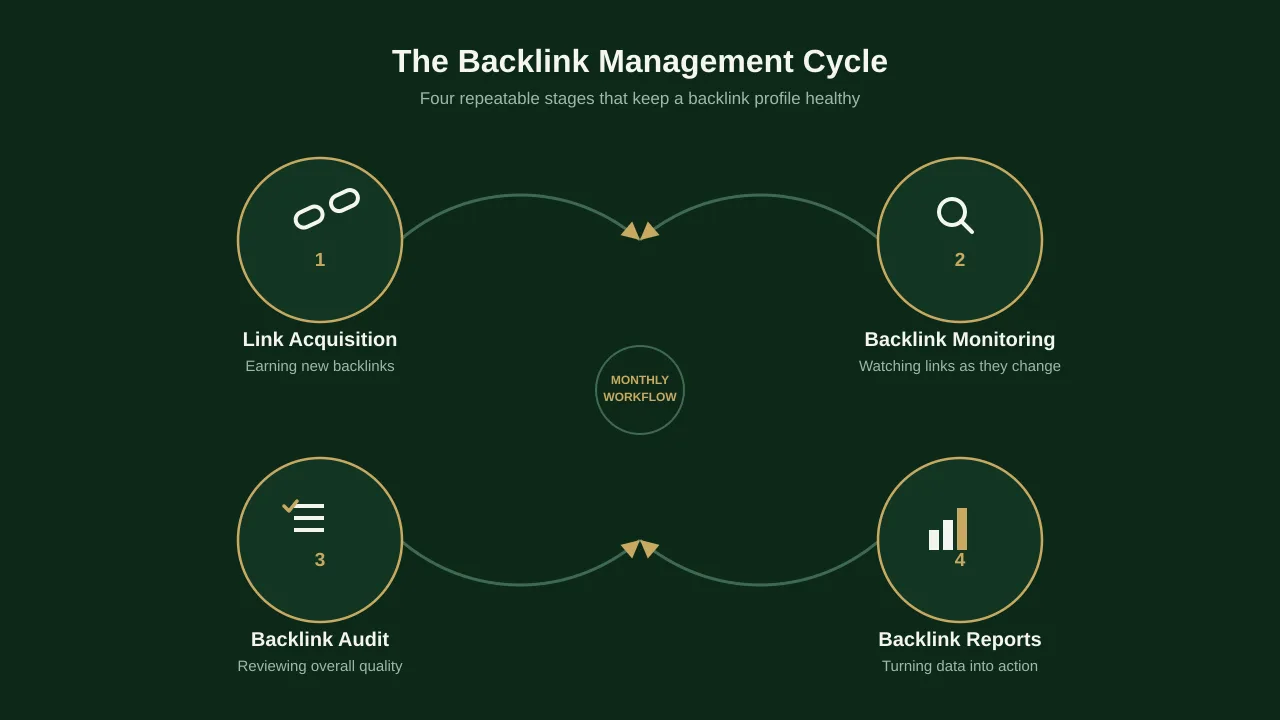
A full backlink management process runs through four stages:
- Link acquisition: Earning new, topically aligned backlinks.
- Backlink monitoring: Watching links as they change or drop.
- Backlink audit: Reviewing overall link quality and toxicity.
- Backlink reports: Turning link data into actionable improvements.
Together, these stages form a repeatable backlink workflow your team can run monthly.
Backlink Management vs. Link Building vs. Link Auditing
Backlink management is the umbrella term. Backlink building sits inside it, focused on earning links through a dedicated link building campaign or proactive outreach. Comprehensive off-page SEO balances both active acquisition and protective maintenance. A backlink audit is another piece, focused on reviewing links you already own. Management is the full loop; building and auditing are single steps in that loop.
Key Backlink Metrics and Terminology to Know
- Referring domains: Unique sites linking to you.
- Domain authority: Predicted ranking strength across search engines.
- PageRank / Page Rating: Google's original link-value calculation.
- Trust Flow: How trustworthy linking sites are based on seed sites.
- Citation Spam Score: Risk level in a site's link neighborhood.
- Domain age: How long a domain has actively existed.
Links also carry link juice, sometimes called link weight, which is the ranking value passed during link passing. Backlink tracking tools help you watch this value move across your profile.
Why Backlink Management Is Essential for SEO in 2026
Backlink management matters more than ever in 2026. Backlinks remain one of the strongest ranking signals search engines use to judge a page. Skip it, and your search visibility can slip even if your content stays the same.
How Backlinks Build Domain and Page-Level Authority
Inbound links work like citations in a research paper. High-authority backlinks pass more value than links from unknown pages. Editorial links, added because your content earned them, carry extra weight. Contextual links inside relevant paragraphs boost topical relevance too.
How Backlinks Influence Traditional Search Rankings
SERP rankings still respond to link signals. One-way links, where a site links to you without a link back, tend to feel more natural and carry more weight in results.
The Role of Backlinks in AI Search, AI Overviews, and LLM Citations
AI Overviews don't always rely on direct clicks. Within generative engine optimization, answer engines frequently weigh co-citation—when your brand appears beside trusted industry sources—and co-occurrence, when your brand name sits near key topic terms across authoritative pages.
Protecting Rankings and Traffic Through Algorithm Updates
Every algorithm update carries risk for messy link profiles. Google's Penguin update, aimed at spam links, still echoes through today's automated spam systems. Sites skipping regular checks often see ranking drops right after an update.
Avoiding Manual Actions and Link-Based Penalties
A manual action can wipe out rankings overnight. This kind of Google penalty usually traces back to link schemes, paid links, or link buying. Penalty recovery takes time and needs a full cleanup first.
Business Impact: Brand Visibility, Referral Traffic, and Pipeline
Good links send direct referral traffic from the sites hosting them. Paired with organic traffic gains, this builds a real ROI you can show in any report.
What Happens When You Ignore Your Backlink Profile
An ignored backlink profile rarely stays clean. Toxic backlinks pile up unnoticed, link rot sets in as old pages vanish, and link dilution spreads your authority too thin. A hacked website can even add spam links you never approved.
Anatomy of a Healthy Backlink Profile
A healthy backlink profile looks balanced, not bloated. Backlink health depends more on relevance than link quantity alone; a smaller link portfolio of strong sites often beats a huge pile of weak ones. Link diversity, meaning varied domains and formats, keeps things looking natural.
Quality Signals: Relevance, Authority, Traffic, and Placement
Link quality comes from a few clear signs. High-quality backlinks sit in the main content, not a sidebar. Link placements near the top pass more value, and links from high-traffic sites carry extra weight.
Dofollow vs. Nofollow, Sponsored, and UGC Attributes
Rel attributes tell search engines how to treat a link according to official Google crawlable link specifications:
- Dofollow: Passes full ranking value and link equity.
- Nofollow: Informs search engines not to associate your site with the target page for ranking purposes.
- Sponsored links: Explicitly flags paid placements and affiliate partnerships.
- UGC links: Marks user-generated content such as forum threads and comments.
A natural profile mixes all four types.
Anchor Text Distribution and Over-Optimization Thresholds
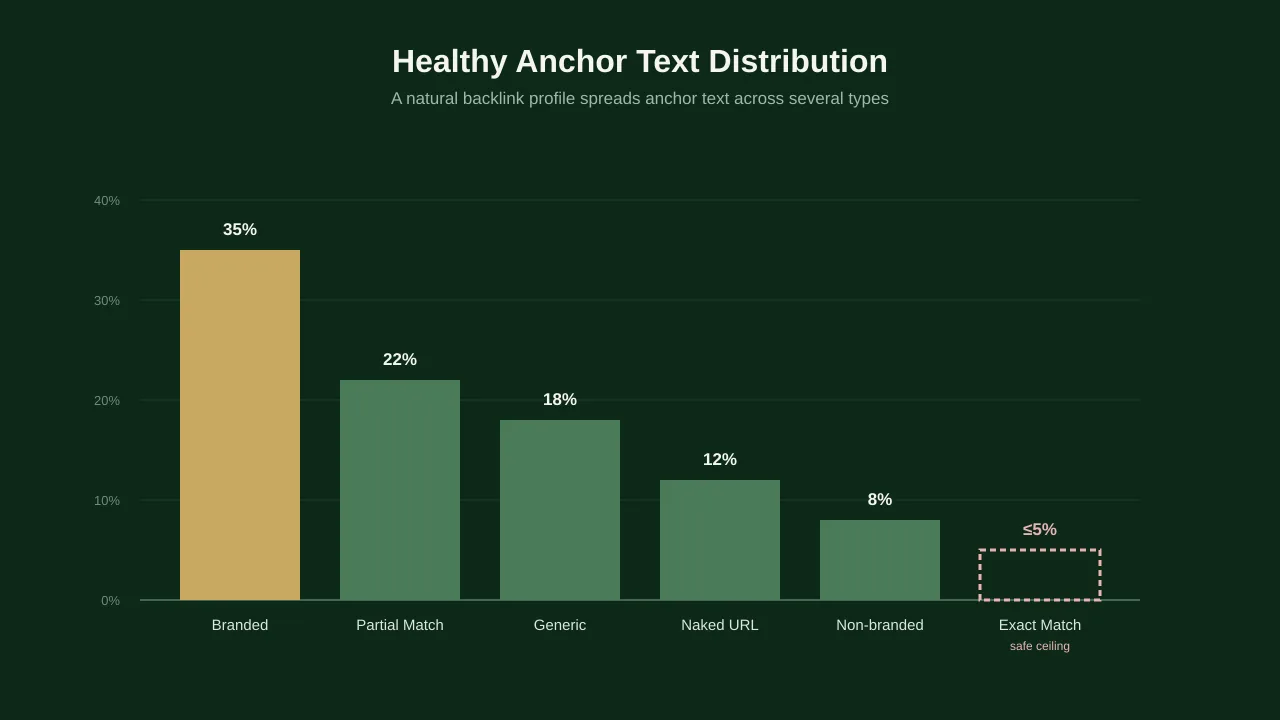
Anchor text is the clickable link text, and anchor text distribution should stay varied:
- Branded anchor text
- Exact match anchor text
- Partial match anchor text
- Generic anchor text
- Naked URL anchor text
- Non-branded anchor text
Smart anchor text optimization keeps exact match anchors under roughly 5% of total links. Over-optimized anchors, repeated too often, trigger spam filters instead of rankings.
Homepage Links vs. Inner-Page (Deep) Links
Homepage links point to your main domain, while deep links reach inner pages like blog posts. External links from footer placements or sitewide links across many pages can look manipulative if overused.
Link Velocity and Natural Growth Patterns
Link velocity tracks how fast new links arrive. Natural links come in steady waves; unnatural links arrive in sudden bursts, hurting link naturalness. IP diversity, links from varied hosting locations, signals a genuine pattern.
Toxic Link Patterns and Early Warning Signs
Watch for:
- Spammy backlinks from unrelated foreign sites
- Problematic backlinks tied to gambling or adult content
- Low-quality backlinks and low-value links with no real traffic
- Irrelevant links sharing no topic connection
- Link farms and private blog networks
- Reciprocal linking loops
These signal link manipulation, whether through black hat SEO or softer grey hat SEO shortcuts.
How to Audit Your Backlink Profile: A Step-by-Step Framework
Auditing sits at the center of the backlink management process. It starts with backlink discovery and ends with link cleanup.
Step 1: Select Your Backlink Data Sources and Tools
Use trusted backlink tools. A backlink checker or backlink analyzer like Ahrefs, SEMrush, Moz, or Majestic pulls data from crawl indexes. Cross-check against Google Search Console for links Google has actually found.
Step 2: Export, Deduplicate, and Consolidate Link Data
Export data into a spreadsheet or CSV file, merge sources, and remove duplicates. A browser extension speeds up manual checks, and a simple link map shows how everything connects.
Step 3: Segment Links by Quality, Intent, and Landing Page
Group links by target page and quality tier. Counting unique referring domains gives a clearer picture than raw link counts, and it reveals your link footprint across the web.
Step 4: Flag Toxic, Broken, and Lost Backlinks
Mark lost backlinks that once pointed to you but no longer do. Run toxic link detection on the rest, checking spam scores and relevance.
Step 5: Take Action — Remove, Redirect, Reclaim, or Disavow
- Try backlink removal with a direct link removal request.
- Use 301 redirects when a page has moved.
- Ask for replacement links when old content changes.
- For links you cannot remove manually, compile them and submit them according to the Google disavow tool documentation.
Disavowal should always be the last resort.
Step 6: Surface High-Value Link Gaps and Opportunities
Backlink competitor analysis reveals your link gap, links rivals have that you don't. Link gap monitoring keeps this updated, feeding a running list of link opportunities and link prospects for ongoing link prospecting.
Step 7: Execute a Strategic Outreach Campaign
Use clear outreach email templates and plan outreach follow-ups, since most replies come after the second message. Relationship building beats one-off asks. Strategic approaches like a curated link insertion strategy, digital PR, and guest contributions offer steady link paths.
How to Monitor Backlinks Continuously
Backlink monitoring keeps your profile in check after the audit ends. Active monitoring means checking tools daily; passive monitoring relies on scheduled alerts. Pick a monitoring schedule that fits your site's size.
Setting Monitoring Frequency by Site Size and Link Velocity
Larger, fast-growing sites need daily monitoring or real-time monitoring. Smaller sites can rely on monthly audits or quarterly audits, with backlink spot-checks in between.
Alerts for New, Lost, and Modified Links
Set backlink alerts so new backlinks appear immediately. A backlink dashboard keeps data in one view, and Google Alerts flags brand mentions across the web.
Detecting Link Deletions, Nofollow Swaps, and Redirect Changes
Sites sometimes change canonical tags or rel attributes without warning. Check indexability and crawlability regularly, since search engine crawlers must reach a page before its links count.
Spotting Negative SEO and Spam Link Attacks
Negative SEO attacks often show up as a sudden backlink spike from spammy domains. Confirm the pattern before acting, since disavow misuse can strip value from real links too.
Monitoring Competitor Backlink Acquisition
Watching a competitor's link graph over time shows which sites are actively linking in your niche, giving early clues on future opportunities.
How to Prioritize Backlinks for Maximum Impact
Link prioritization helps you focus limited time on the links that matter most. Link curation means choosing targets on purpose, not chasing every mention.
Scoring Links by Value, Risk, and Effort
Score each opportunity on value, effort, and risk. A quick risk assessment before outreach saves time on sites unlikely to respond or worse, likely to harm your profile.
Mapping Links to Money Pages and Revenue Goals
Point your best outreach at pages that drive revenue. A link to your pricing page usually matters more than one to a random blog post.
Decision Matrix: Fix, Reclaim, Ignore, or Disavow
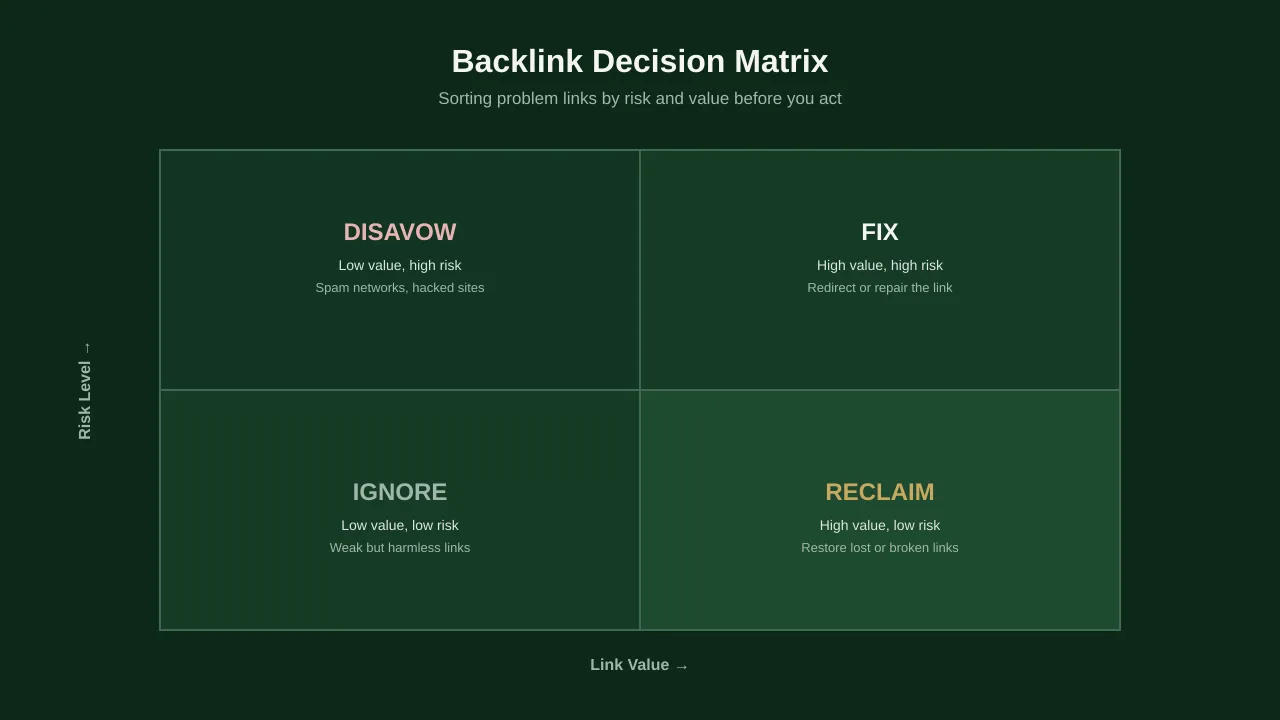
Build a simple matrix: fix broken links, reclaim lost ones, ignore harmless weak links, or disavow dangerous ones. When you disavow, follow Google's exact disavow file format, one domain or URL per line.
Backlink Management Best Practices, Tips, and Tactics
Sustainable backlink management leans on link earning, not shortcuts. White hat SEO protects your site long term. Build linkable assets through content marketing, and try the skyscraper technique to improve on top-ranking content.
Reclaim Lost and Removed Backlinks
Link reclamation means finding broken or missing links and getting them restored, often with a quick email to the site owner.
Fix Broken Backlinks and Orphaned 404 Targets
Broken backlinks pointing to 404 errors waste value daily. Coordinate with your technical SEO roadmap to fix them with direct 301 redirects, and avoid long redirect chains that weaken authority signals.
Convert Unlinked Brand Mentions Into Links
Unlinked brand mentions appear when a site names you without linking. Search articles and online communities, then ask for the link addition.
Disavow Low-Quality Links (and When Not To)
Save disavow for real threats. Non-spammy links, even weak ones, rarely need disavowing since they cause no real harm.
Distribute Link Equity With Internal Linking
Internal links spread link equity from strong pages to newer ones, helping backlinks earned by your homepage flow deeper into your site.
Build Publisher and Webmaster Relationships
Long-term links come from real relationships. Stay in touch with webmasters you've worked with, since repeat links come easier once trust exists.
Reverse-Engineer Competitor Link Profiles
Study what earns competitors links, then build better. Original research and infographics work well as link bait. Check resource pages for resource links, plus directory links and influencer links rivals already hold.
Document Workflows, Owners, and Standard Operating Procedures
Write down every step so nothing depends on one person. Clear procedures paired with backlink management training keep your team consistent as roles change.
Keeping Link Acquisition Safe, Sustainable, and Guideline-Compliant
Stick to methods you'd explain to Google directly. White hat SEO takes longer but never puts your site at risk.
How to Track Backlink Performance Over Time
SEO reporting turns raw link data into a story stakeholders understand. Track the same numbers every cycle so trends become obvious.
KPIs That Actually Correlate With Rankings
Focus on KPIs like referring domain growth, average authority of new links, and lost link rate, since these connect more directly to ranking movement than raw link counts.
Attributing Rankings, Traffic, and Conversions to Links
Match ranking jumps and traffic gains to the dates your best links went live. This timeline view shows which links truly moved results.
Measuring Link Retention, Decay, and Time-to-Impact
Track how long links stay live and how fast new ones start showing effects. Some links help within weeks; others take months.
Dashboards and Reporting Cadence for Stakeholders and Clients
Build custom reports that match how often stakeholders want updates. A clean dashboard beats a long spreadsheet every time.
Best Backlink Management Tools for 2026
Backlink automation now handles much of the repetitive tracking work. A good backlink builder helps you find and organize new inbound links faster than manual searches, and since backlinks keep shaping rankings, the right tool stack saves real time.
How Backlink Management Software Differs From Traditional SEO Suites
General SEO suites cover keywords, content, and technical checks together. Dedicated backlink management software focuses only on links, offering deeper monitoring and cleanup features.
Must-Have Features Checklist
Look for real-time alerts, toxic link scoring, disavow file export, competitor comparison, and clear dashboards.
Base, LinkDog, Backlink Manager, SEOJet, and SE Ranking
Each platform brings its own strength, whether outreach tracking, link health scoring, or built-in reporting templates. Compare a few before committing long term.
Google Search Console
Search Console offers a free, direct view into links Google has actually indexed, a solid baseline against any paid tool.
Google Alerts
Google Alerts costs nothing and quietly flags new brand mentions, some of which turn into easy link opportunities.
Tool Comparison and Choosing the Right Tool
Pick tools based on site size, budget, and how much manual work your team can handle. Test a free trial before paying upfront.
In-House vs. Agency vs. Outsourced Backlink Management
Running link work in-house gives full control but takes time and skill. An SEO agency brings experience and existing relationships that often speed up results. Outsourced link building through dedicated backlink building services works well for teams needing scale without hiring in-house.
Backlink Management Across Industries and Site Types
- Ecommerce: Product and category links, deal roundups.
- SaaS-B2B: Comparison articles, directories, guest posts.
- Local: Local citations, community sites.
- Publishers: Editorial links, syndication partners.
- Affiliate: Diverse anchors, review site links.
- YMYL: Strong E-E-A-T signals through trustworthy links.
Common Backlink Management Mistakes to Avoid
- Disavowing links out of fear, not data
- Chasing quantity over quality
- Ignoring the profile until a penalty hits
- Skipping outreach follow-ups
- Forgetting to watch competitor link growth
Building Your 90-Day Backlink Management Plan
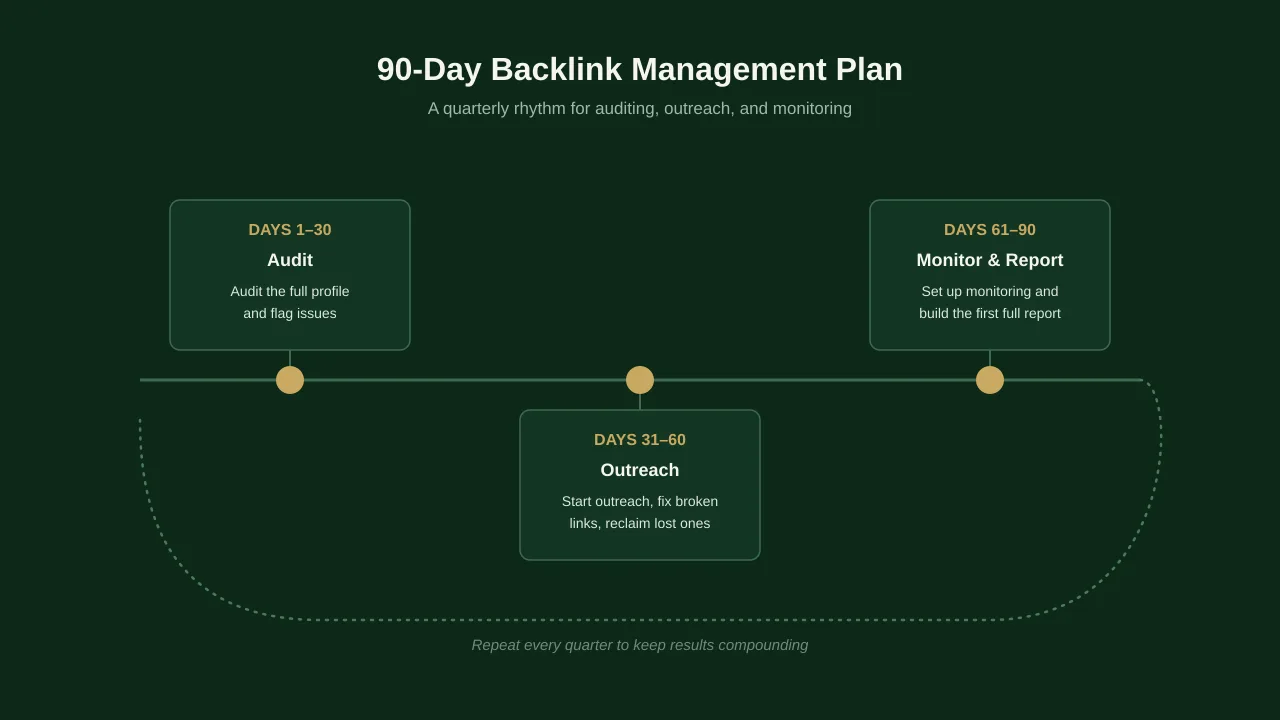
- Days 1–30: Audit your full profile and flag toxic or broken issues.
- Days 31–60: Start outreach, fix broken links, and reclaim lost placements.
- Days 61–90: Set up continuous monitoring and build your first comprehensive report.
Repeat every quarter to keep results compounding.
Frequently Asked Questions
Are backlinks still relevant in 2026?
Yes. They remain a core ranking signal even as AI search grows.
What is an example of a backlink?
If a blog links to your site from one of its articles, that's a backlink.
How often should you audit your backlinks?
Most sites benefit from a full audit every quarter, with spot-checks between.
Do backlinks need constant monitoring?
Not constant, but regular. Weekly or monthly checks catch problems early.
How do I identify a valuable backlink?
Look for relevance, real traffic, and a trustworthy site history.
Are homepage links more important than inner-page links?
Not always. Inner-page links often help specific pages rank faster.
Should nofollow backlinks be part of your strategy?
Yes. They still bring referral traffic and keep a profile natural.
Which backlinks should you disavow immediately?
Links from clear spam networks, hacked sites, or paid link schemes tied to manual actions.
Do I need backlink management software if I already use Ahrefs or Semrush?
Often yes, since dedicated tools add deeper monitoring and cleanup features.
How do these tools handle lost links and link deletions?
Most send an alert the moment a tracked link disappears.
Can backlink management be outsourced safely?
Yes, as long as the provider follows white hat methods and reports clearly.
How much do paid backlinks cost?
Prices vary widely, often $50 to $500 per link, but they carry real penalty risk.
Can poor backlink management hurt my site?
Yes. Ignored profiles can lead to ranking drops, lost traffic, or a manual action over time.
Need a Technical SEO Audit or Strategy Call?
Connect directly on WhatsApp to review your site speed, topical architecture, and organic growth roadmap.